
Your Child Won't Listen? 7 Solutions Without Yelling
Founder, GritSprout
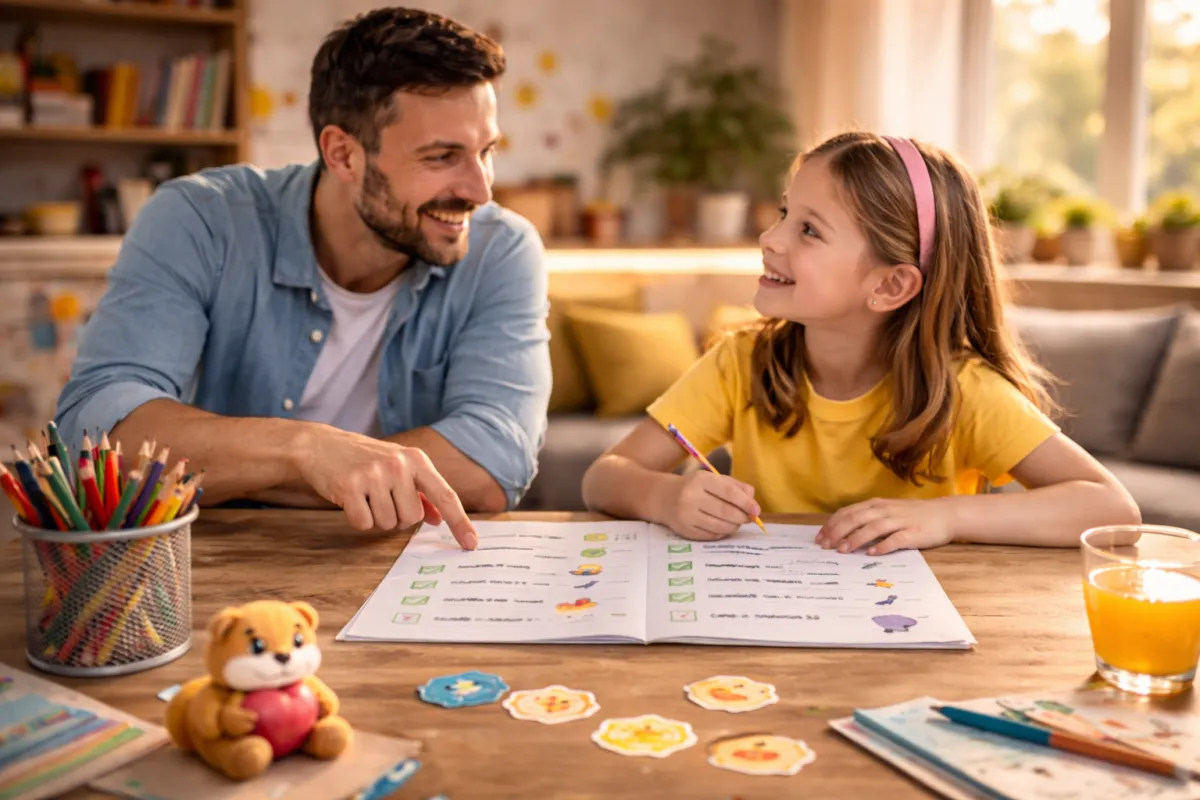
"How many times do I have to tell you?" If you've counted, it's probably more than 10 per day. But your child isn't ignoring you out of spite. Developmental psychology research shows that what looks like defiance is often a combination of lack of visibility, lack of autonomy, and lack of concrete motivation. Your child doesn't do what you ask not because they don't want to - but because the system they operate in doesn't help them do it alone.
1. Make the request visible, not verbal
Repeated verbal instructions become background noise. The child's brain filters the request the same way you filter car horns in traffic - not out of rudeness, but from neurological adaptation.
What works: a visible list the child checks on their own. When "brush your teeth" is written on a list the child sees daily, they no longer depend on your voice. Responsibility shifts from "mom told me" to "I have to do this."
2. Give short, concrete instructions
CDC recommends instructions of 1-2 steps maximum, stated positively. "Put your shoes on the rack" works. "Be tidy" doesn't - it's too vague.
The rule: if your instruction has more than 10 words, the child lost it halfway through. Simplify.
3. Offer choices, not orders
When the child feels something is being imposed, resistance rises automatically. Ryan and Deci (2000) show that autonomy is one of the three basic psychological needs.
What works: "Do you want to brush your teeth before or after making your bed?" The child does the same thing, but feels they chose. The difference is enormous.
4. Replace repetition with a system
If you're repeating the same request 5 times a day, you need a system, not more patience. A system means: activities are listed, the child checks them off, progress is visible.
Without a system: you ask, child ignores, you get frustrated, child cries.
With a system: the child opens the list, checks off, sees the streak growing. You said nothing.
5. Connect effort with a specific reward
"Good job" is not a reward - it's a sound. A specific reward means: "7 days with all activities checked = ice cream from mom." The child sees exactly what to do, how many days are left, and what they get.
The meta-analysis by Cerasoli, Nicklin, and Ford (2014) shows that external incentives can contribute to performance, especially for routine tasks the child doesn't yet do from intrinsic motivation.
6. Don't withdraw - natural consequences
Withdrawing a reward ("No movie for you!") turns the reward into punishment. The child associates effort with risk, not gain.
What works: natural consequences. If the child doesn't check off activities, the streak resets and the prize doesn't come. You didn't yell, you didn't threaten. The system worked on its own.
7. Show progress, not just the result
Streaks work because they show progress in real time. "You have 5 days in a row" is more motivating than "be good." The child doesn't want to break the streak - and each checked day makes the next day more likely.
Lally et al. (2010) show that forming a habit takes an average of 66 days of consistent repetition. A visible streak helps the child get there.
How GritSprout helps specifically
GritSprout implements all 7 solutions in one app: a visible daily activity list, child-driven check-offs, automatic streaks, concrete family prizes, and real-time visible progress. Setup takes a few minutes, and the child can check off on their own from any phone or tablet.
Your child isn't ignoring you. They just can't see what's in your head. Make it visible - and you'll never have to repeat yourself.
Done repeating yourself
GritSprout makes the routine visible, tracks the streak, and connects the prize with effort. The child checks off alone, you stop asking.
Frequently asked questions
References
- Ryan & Deci (2000), Self-determination theory and the facilitation of intrinsic motivation, social development, and well-being
- Cerasoli, Nicklin & Ford (2014), Intrinsic motivation and extrinsic incentives jointly predict performance: A 40-year meta-analysis
- Lally et al. (2010), How are habits formed: Modelling habit formation in the real world
- CDC, Steps for Giving Good Directions